The Shops That Stayed
Most people meet Rome through its monuments.
The Colosseum
Spanis Steps
The Pantheon
Vatican City.
They walk, they look up, they take it in. And it makes sense. Rome asks to be admired.
But if you stay a little longer, if you slow down between one landmark and the next, another Rome begins to appear. A quieter one. A Rome that lives behind counters, inside workshops, in places that open every morning and close when the work is done.
In the historic center, even on streets many people rush through on the way to something else, there are shops that have been operating for more than seventy years. In many cases, the same family is still there, now in its third generation. The city recognizes them as negozi storici di eccellenza, historic shops of excellence.
The name sounds formal. The reality is not.
You don’t enter these places as a visitor. You enter as someone who needs something. A plate. A pen. A piece of clothing. A box of pasta to bring home. A small gift. Something that belongs to daily life.
Most visitors pass through Rome following a familiar path. From the Pantheon to Piazza Navona. From Campo de’ Fiori to Trastevere. From the Jewish Ghetto toward Teatro Marcello. They move quickly, camera in hand, unaware that some of the most enduring parts of the city are not monuments at all.
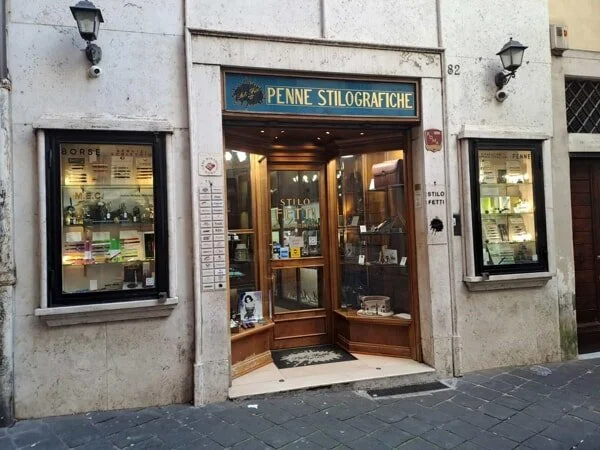
Just steps from the Pantheon, on a narrow street many people rush through, Stilo Fetti has been selling pens for generations. Not souvenirs. Pens meant to be used. Chosen carefully. Held in the hand. It’s the kind of place where writing still feels like an act worth slowing down for.
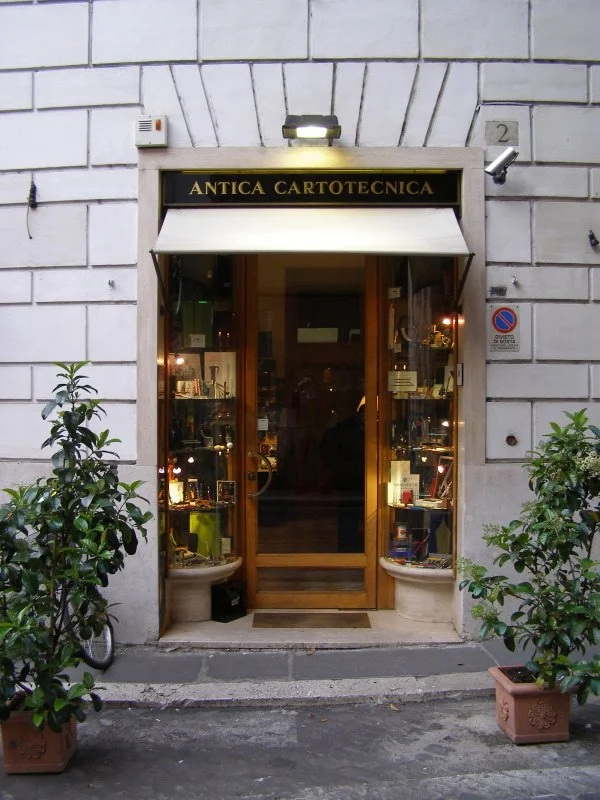
A few minutes away, Antica Cartotecnica lives in a world of paper, ink, and objects that belong on a desk. The smell alone tells you this is not nostalgia. It’s continuity. Artists, professionals, and collectors still come here for the same reason they always have. Someone inside knows exactly what you’re looking for, even before you do.
Cross toward the Jewish Ghetto, an area layered with Roman life and history, and you find Leone Limentani, facing the Portico d’Ottavia and a few steps from Teatro Marcello. It began as a place for everyday tableware and grew into something much rarer. A house of taste for the table. Porcelain, crystal, services chosen like a tailor chooses fabric. Over time, the work passed down through generations, and the shop became the kind of place that quietly furnished lives, not just homes.
Nearby, Rome keeps time in a different way. Not only through ruins and bell towers, but through places like Bedetti, where watches and jewelry have been part of the city for more than a century. It’s a shop that has seen Rome change, and kept its standard anyway. The kind of place where people return because they trust the hands behind the counter, not because of a logo.
Food lives inside this world too, without needing to announce itself.
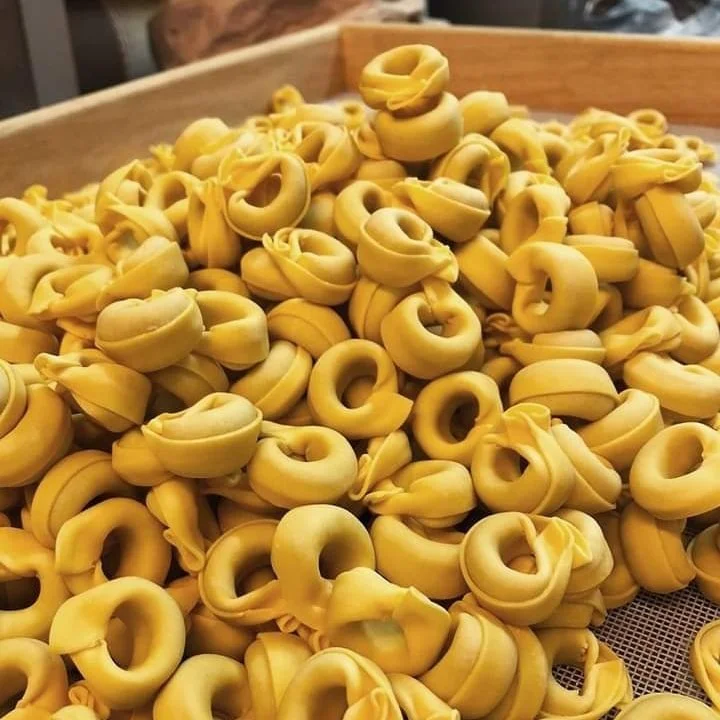
In Rome, pasta shops like Pasta all’Uovo Marini, founded in 1930, or Gatti e Antonelli, active since the 1950s, are not destinations. They are part of the rhythm. Places where pasta is bought, taken home, cooked, and eaten. No story required. The story is in the repetition.
And in Trastevere, beyond the noise and restaurants, Biscottificio Innocenti has been working since 1940. You don’t need a sign to understand what it is. You smell it before you see it. Locals stop in. Boxes are wrapped. Life continues.
There are other shops that carry this same thread through different crafts.
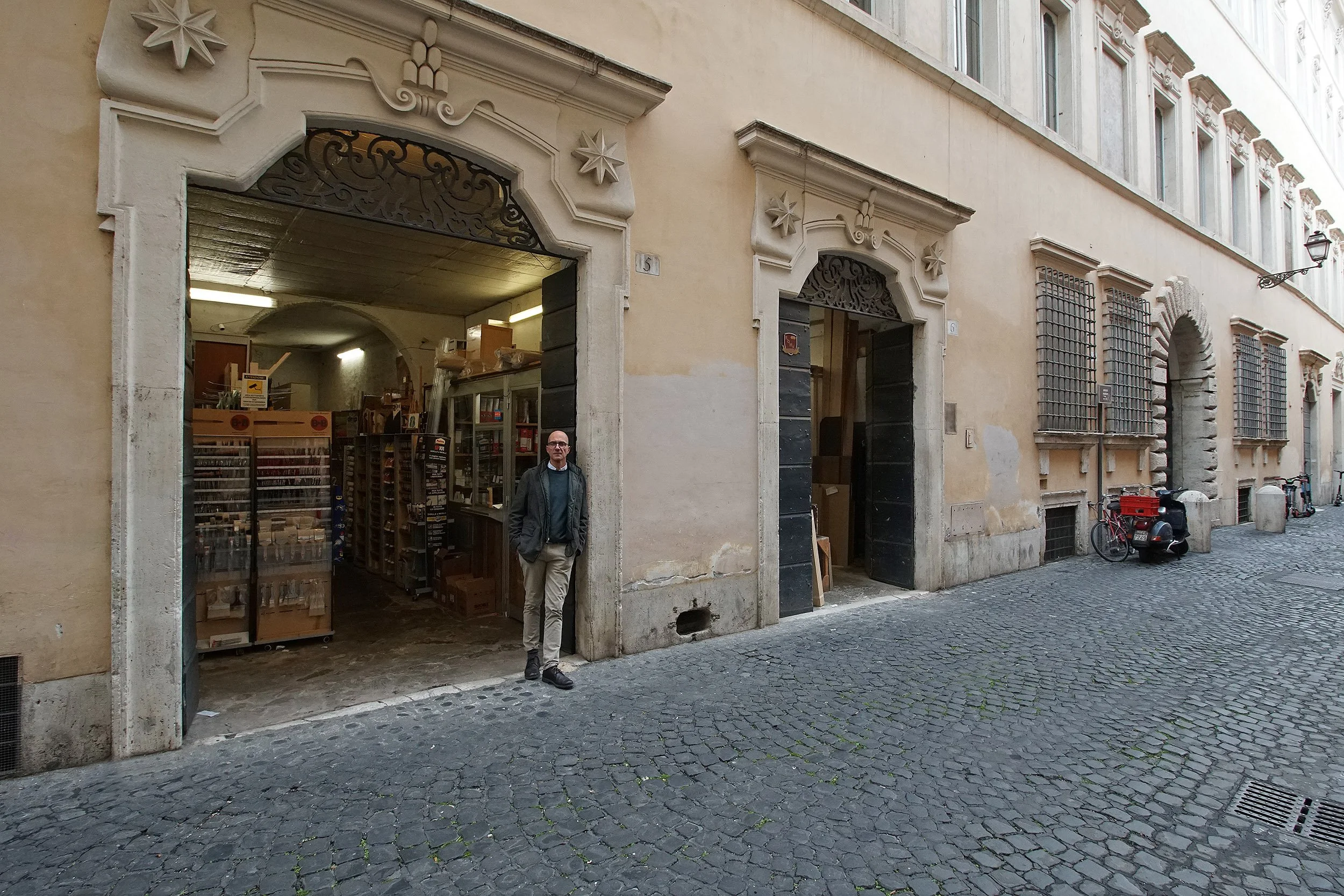
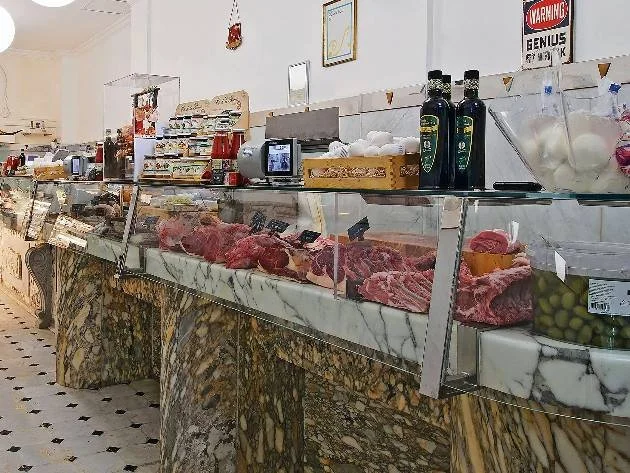
A butcher like Angelo Feroci. A wood shop like Ditta Francesco Paolucci, where the smell of lumber and the precision of the work still matter. A place like Fincato – La Casa del Habano, where ritual and conversation have their own pace. Or Il Paralume, where a family’s love for art, restoration, and Roman beauty shaped a life through objects as simple as light.
It’s tempting to think of these places as “old Rome.” But that’s not true. They are not frozen. They are alive. They adapted to survive, but they didn’t break the thread.
This idea doesn’t belong only to Rome. It belongs to all Italy, region by region.
You can find it again in Emilia Romagna, where culture and terroir are inseparable. Where Parmigiano Reggiano is made by families who never left. Where balsamic vinegar takes decades. Where knowledge is carried in gestures and routines, not marketing.
For us, this is where culture lives.
Not in dates or plaques, but in continuity. In people who stayed. In places that still serve locals, even when the city around them becomes a stage.
This is also how we travel.
We don’t rush from monument to monument. We move through cities and regions paying attention to where life still happens. We step into shops where the work continues quietly. We taste food that makes sense because it belongs to the land. We understand that history is not something behind glass. It’s something you can still touch.
Italy teaches this, if you let it.
Some doors don’t ask to be admired. They ask to be opened.
Shops we love:
Stilo Fetti
Via degli Orfani 82, Rome
Pen and fine writing instruments shopAntica Cartotecnica
Piazza dei Caprettari 61, Rome
Luxury stationery and paper goods shopLeone Limentani
Via del Portico d’Ottavia 47, Rome
Tableware and floral design shopBedetti
Piazza San Silvestro 9–12, Rome
Watch and jewelry storeAngelo Feroci
Via della Maddalena 15, Rome
Butcher shopPasta all’Uovo Marini
Via Po, Rome
Fresh pasta shopGatti e Antonelli
Via Nemorense, Rome
Fresh pasta shopBiscottificio Innocenti
Trastevere, Rome
Biscuit and traditional sweets bakeryDitta Francesco Paolucci
Via di Montoro 5, Rome
Carpentry and woodworking shopFincato – La Casa del Habano
Via della Colonna Antonina 34, Rome
Tobacco, cigars, and smoking accessories shopIl Paralume
Via di Monserrato 50, Rome
Lighting and home decor shop
Photos used are not owned by Luca Italian Experiences.