Festa del Papà: March 19 in Italy
In Italy, some days carry more than one meaning without needing to explain it.
March 19 is one of them.
It is the day of Saint Joseph’s Day, dedicated to a quiet figure. A father, a worker, a man who built his life through responsibility rather than words. In the Catholic tradition, he is also the patron of carpenters. Someone who works with his hands, who creates, who provides.
Over time, this day became something more familiar. In Italy, and in many Catholic countries, March 19 is also Father’s Day.
But it does not feel like a performance. It is not loud. It is not decorated.
It is a day that moves gently, almost like the rest of Italian life.
Growing up, you do not really notice what this day means. It is just there. You go to a pasticceria and see trays filled with cream-filled pastries that only appear once a year. You bring them home. You eat them after lunch. Someone makes a comment. Someone else pours coffee.
Only later you understand that this day is not really about celebration. It is about recognition.
In Italy, the role of a father has always been a little different from what people imagine.
He is not always the one who speaks the most. Not always the one who decides everything. That space is often shared, sometimes even led by the mother in everyday life.
But the father holds a different kind of place.
He is what people here call the colonna portante della casa. The structure that holds everything in place. Not visible in every moment, but always present. You feel it more than you see it.
Respect is not announced. It builds over time.
There are also stories in Italy where a father does not just guide a family, but helps shape something that goes beyond it.
Not loudly. Not all at once. But over time.
In industry, Giovanni Agnelli built what would become FIAT, helping industrialize a country that was still finding its place in the modern world. He was not only a businessman, but a figure who understood direction and responsibility.
His son, Gianni Agnelli, grew into something different. Known as L’Avvocato (The Lawyer), he became the face of Italian capitalism and style. What he inherited, he transformed. What was built before him, he carried forward with his own identity, turning FIAT into a global presence and becoming one of the most influential private figures in Italy.
On the football (Soccer) field, something similar happened in a quieter, more visible way.
Cesare Maldini and his son Paolo Maldini represent more than talent. In a country where football (Soccer) is part of daily life, they became a reference point for consistency, discipline, and respect for the game. Watching them, it never felt like a break between generations. It felt like continuity.
In music, the connection becomes even more immediate.
Andrea Bocelli brought a voice from Italy to the world, making classical music feel accessible to people who had never listened to it before. Today, seeing him perform alongside his son Matteo Bocelli, you understand something else. Not just inheritance, but guidance. Technique, presence, timing. A transition that happens slowly, in front of you.
In hospitality, the story takes another form.
Giuseppe Cipriani opened Harry’s Bar in Venice in 1931. A place that became known not only for what it served, but for how it made people feel. The Bellini, the carpaccio, simple things done with precision.
His son, Arrigo Cipriani, did not change that idea. He protected it and carried it forward, expanding it beyond Venice. What began as a single bar became a name recognized in New York, London, Miami. Not as a chain, but as a way of understanding hospitality. Quiet elegance. Consistency. Simplicity that requires discipline.
And in a more recent generation, you see the same rhythm continue.
Oscar Farinetti created Eataly with a clear idea. To explain Italian food culture in a way that people could experience, not just read about. Today, that idea continues to grow, carried forward by his kids with the same direction, across different cities and countries.
These stories feel different on the surface, but they share something.
A father sets a direction.
A son/daughter learns how to carry it.
And over time, something larger takes shape.
And then, as always in Italy, everything comes back to the table.
For me, March 19 has always meant one thing.
The bignè.
Every year, without exception, there is a moment when you walk into a pasticceria and see them lined up. You do not need to ask why. You already know the day.
The bignè di San Giuseppe are soft, filled with pastry cream, sometimes still slightly warm outside, cold and smooth inside.
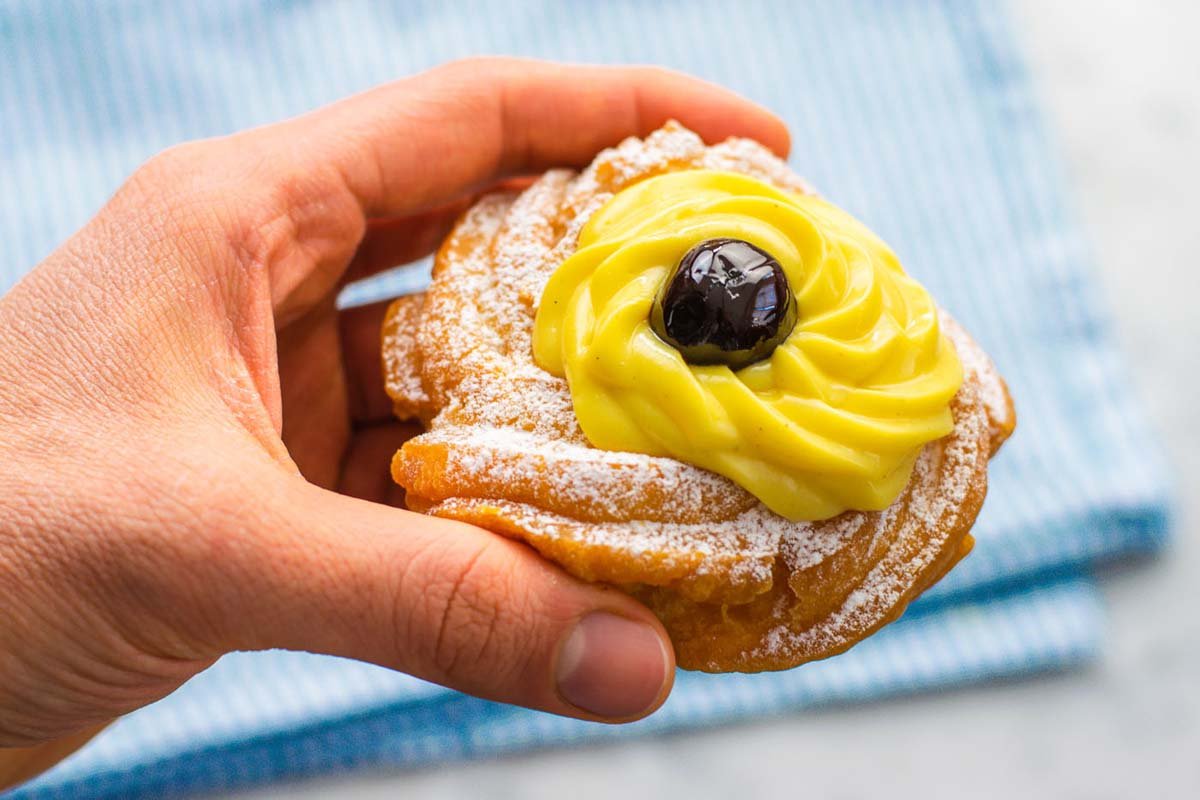
A perfect Bigne di San Giuseppe. Filled with pastry cream and topped with a cherry.
You take one. Maybe two.
The cream is light, not too sweet. There is often a cherry on top. Nothing complicated, but it stays with you.
It is one of those things I cannot go without. Even if only for one or two days a year.
And when you look around, you notice something else.
Kids eating them slowly, carefully, trying not to let the cream fall. Parents watching, smiling without saying much. It is not just about the pastry.
It is about repetition.
It is about knowing that this same thing happened last year, and the year before, and will happen again.
In Sicily, the version changes.
The sfincia di San Giuseppe, larger, softer, richer, filled with ricotta and often finished with pistachio or candied fruit.

A very Sicilian Sfincia di San Giuseppe, filled with ricotta and candied fruit.
Different shape, different texture. Same idea.
A tradition you do not question. You just take part in it.
What stays, in the end, is not the date or even the tradition itself.
It is the feeling that something continues.
A father who shows up without needing to explain it. A gesture repeated over time. A recipe that returns every year without being announced.
In Italy, these things are rarely made into statements. They are simply lived.
March 19 passes quietly, like many things here.
But it leaves something behind.
These are the kinds of traditions that shape Italy in ways that are not always visible at first.
If you are thinking about your own journey, we would be happy to help design a trip that brings you closer to these moments, the ones that make the country feel real.
Where to Find Bignè di San Giuseppe in the U.S.
If you want to try this pastry and be part of the italian tradition on March 19, a few places still carry this tradition forward in America. Small reminders of home, often found quietly behind a pastry counter.
New York
Veniero’s Pasticceria & Caffè — East Village
Ferrara Bakery & Café — Little Italy
Roscioli NYC — the New York home of the Roman family behind Roscioli
California
Emporio Rulli — Larkspur (Luca’s favorite)
Poul’s Bakery — Orange County
Texas
Pietro’s Italian Bakery — Houston
Belli Baci Bakery & Caffè — Austin
Washington, D.C. area
Bisnonna Bakeshop — Virginia
Florida
Pistacchio Pane e Caffè — Miami